
Skin Tightening Abu Dhabi 2026–2027: Personalized Non-Surgical Treatments at Enfield Royal Clinic
📊 Key Facts
- Skin laxity treatment requires personalized assessment based on individual skin anatomy
- Abu Dhabi's high UV exposure and heat accelerate collagen degradation faster
- Enfield Royal Clinic uses DOH-licensed practitioners for non-surgical skin tightening
- Collagen and elastin naturally decline from late twenties onwards
- Right treatment depends on skin anatomy, degree of laxity, and lifestyle
Skin laxity is one of the most common aesthetic concerns among adults in Abu Dhabi — and one of the most misunderstood. Walk into almost any clinic and you will encounter broad promises about lifted, firmer skin. What you are less likely to find is an honest explanation of why a specific technology is chosen for your skin, what a realistic result looks like, and when you can expect to see it.
This guide exists to close that gap. At Enfield Royal Clinic in Khalifa City, we approach skin tightening as a personalised clinical decision, not a product to be sold. The technology selected for your jawline may differ entirely from what is appropriate for a client with similar concerns but different skin anatomy or degree of laxity. Individual outcomes vary — and understanding why is the first step to making an informed choice.
Why Skin Laxity Occurs: Abu Dhabi's Climate Factor
Collagen and elastin — the structural proteins that keep skin firm and resilient — begin to decline naturally from the late twenties. In Abu Dhabi, however, environmental factors accelerate this process considerably:
- UV exposure: Year-round high UV index in the UAE degrades collagen faster than in temperate climates, particularly affecting the neck, décolletage, and areas not consistently protected by SPF.
- Heat and dehydration: Chronic heat exposure and air conditioning reduce skin hydration levels, compromising the extracellular matrix that supports skin architecture.
- Lifestyle factors: Rapid weight fluctuations, post-pregnancy changes, and shifts in body composition can stretch the skin beyond its natural recoil capacity.
- Age-related SMAS descent: The SMAS (Superficial Musculoaponeurotic System) — a fascial layer beneath the skin and subcutaneous fat — gradually descends with age, pulling surface skin downward in the mid-face and jawline.
Understanding the source of your laxity matters because different technologies target different tissue depths.

Non-Surgical Skin Tightening: What It Is and How It Differs from Surgery
Non-surgical skin tightening uses energy-based devices or injectable biostimulators to stimulate the skin's own collagen and elastin production — without incisions, general anaesthesia, or the recovery period associated with a surgical facelift.
It is important to be direct here: non-surgical treatments are designed to address mild to moderate skin laxity. They are not a replacement for surgical intervention in cases of significant or advanced tissue descent. A thorough consultation will help clarify which category your concerns fall into. If you are exploring how non-surgical skin tightening compares to a surgical facelift or thread lift, our detailed Thread Lift vs Facelift Abu Dhabi guide is worth reading before your appointment.
Technologies Available at Enfield Royal Clinic: How Each Works
1. HIFU — High-Intensity Focused Ultrasound
HIFU delivers focused ultrasound energy to precise depths beneath the skin surface — typically 1.5mm (dermis), 3mm (deep dermis), and 4.5mm (SMAS layer). The thermal injury at these focal points triggers a wound-healing response, stimulating new collagen over the following months.
Best suited for: Mid-face laxity, jawline definition, brow lifting, and neck tightening in clients with mild to moderate laxity.
What to expect: Initial results may be visible within 4–6 weeks; optimal outcomes typically develop over 3–6 months as collagen remodelling progresses. Most clients require 1–2 sessions per year for maintenance. Results are not permanent — collagen production continues to decline with age.
2. Radiofrequency (RF) Therapy
Radiofrequency energy heats the dermis to a controlled temperature, causing immediate collagen contraction and promoting longer-term neocollagenesis. Unlike HIFU, RF works across a broader tissue area rather than at a single focal depth.
Best suited for: Generalised skin laxity on the face, neck, and body; skin texture improvement alongside tightening.
What to expect: A course of 4–6 sessions (spaced 2–4 weeks apart) is typically recommended before assessing full results. Maintenance sessions every 6–12 months help sustain outcomes.
3. Potenza RF Microneedling
Potenza combines radiofrequency energy with microneedling, delivering RF directly into the dermis via ultrafine needles. This bypasses the epidermis, allowing deeper delivery of thermal energy with greater precision and reduced surface disruption.
Best suited for: Skin laxity combined with concerns about texture, enlarged pores, or mild scarring; particularly effective for the lower face and perioral area.
What to expect: 2–4 sessions are generally recommended. Downtime is typically 24–72 hours of redness and mild swelling — not zero. Results develop gradually over 4–8 weeks per session.
4. Endolift Laser Treatment
Endolift is a minimally invasive laser procedure using a very fine optical fibre inserted beneath the skin to deliver laser energy directly to the subdermal tissue. It stimulates collagen contraction and fat remodelling simultaneously.
Best suited for: Defined areas with early to moderate laxity — commonly the lower face, jawline, neck, and periorbital region. Also used for mild body contouring in localised areas.
What to expect: Results are typically visible within 4–8 weeks, with full collagen remodelling over 3–6 months. As a minimally invasive (not fully non-invasive) procedure, there is a brief recovery period of several days with possible bruising and tenderness.
5. Profhilo and Sculptra — Injectable Biostimulators
These injectable treatments work differently from energy-based devices. Profhilo (highly purified hyaluronic acid) spreads beneath the skin to hydrate and stimulate collagen and elastin. Sculptra (poly-L-lactic acid) triggers a gradual fibroblast response over several months.
Best suited for: Clients with early laxity and significant volume loss; ideal as a complement to energy-based treatments rather than a standalone approach for significant sagging.
What to expect: 2–3 sessions of Profhilo spaced 4 weeks apart; 2–3 vials of Sculptra over several months. Results are subtle and progressive — not immediate.
Technology Comparison at a Glance
| Technology | Target Depth | Primary Concern | Sessions Needed | Visible Results |
|---|---|---|---|---|
| HIFU | 1.5–4.5mm (SMAS) | Moderate facial/neck laxity | 1–2 per year | 3–6 months |
| RF (standalone) | Dermis (broad) | Generalised laxity, body | 4–6 course | 2–4 months |
| Potenza RF Microneedling | Dermis (precise) | Laxity + texture | 2–4 sessions | 4–8 weeks per session |
| Endolift Laser | Subdermal | Jawline, neck, early laxity | 1 (possible top-up) | 4–8 weeks |
| Profhilo / Sculptra | Subcutaneous | Volume loss + early laxity | 2–3 sessions | 1–3 months |
Who Is a Good Candidate?
Non-surgical skin tightening is generally most appropriate for:
- Adults in their mid-30s to early 60s experiencing mild to moderate skin laxity
- Individuals with good general skin health who want to address early changes proactively
- Clients who have experienced post-pregnancy or post-weight-loss changes that have reduced skin elasticity in the face, neck, abdomen, or arms
- Those who are not ready for — or not suitable for — surgical intervention
Candidates with severe or advanced laxity may find that non-surgical options address the concern only partially. In these cases, your practitioner will provide an honest assessment and may recommend a combined or surgical approach. We will not recommend a treatment that is unlikely to meet your expectations.
Realistic Expectations: What Non-Surgical Tightening Cannot Do
This is where many clinics fall short of honest communication. Here is what you should know:
- Results develop gradually — there is no instant lift.
- Maintenance is required — collagen stimulated by these treatments does not last indefinitely. Without repeat sessions, natural ageing continues.
- Degree of improvement is proportional to degree of laxity — mild laxity typically responds more visibly than advanced laxity.
- Individual variation is real — skin biology, lifestyle, sun exposure habits, and genetics all affect outcomes. Individual results vary.
- These technologies are not a substitute for a facelift in cases of significant tissue descent.
Side Effects and Safety: What to Expect
All energy-based skin tightening procedures carry potential side effects. At Enfield Royal Clinic, our DOH-licensed practitioners are trained to minimise risk through proper assessment and calibrated treatment protocols — but no procedure is without risk.
Common, expected side effects (typically resolving within 24–72 hours):
- Redness and warmth at the treated area
- Mild swelling
- Temporary tenderness or sensitivity
Less common side effects:
- Bruising (more likely with Endolift or injectable treatments)
- Temporary numbness or tingling
- Rare: uneven texture or contour irregularity if treatment parameters are poorly calibrated
The risk profile of each technology differs. Your practitioner will discuss this specifically in relation to your chosen treatment at consultation.
The Consultation Process: How We Determine Your Treatment
At Enfield Royal Clinic in Khalifa City, the consultation is the most important part of your journey. Our DOH-licensed practitioners conduct a structured assessment that includes:
- Skin laxity grading — evaluating the degree and location of tissue descent
- Skin type and condition analysis — including sun damage, texture, and hydration status
- Facial anatomy mapping — identifying SMAS position and volume distribution
- Goal alignment — understanding what outcome you are hoping for and setting calibrated expectations
- Medical history review — to identify contraindications
This process directly determines which technology — or combination of technologies — is recommended. No two treatment plans are identical, because no two clients share the same anatomy or ageing pattern.
To book your consultation — currently available at no charge — visit our free consultation guide for Abu Dhabi clients.
For a deeper look at skin tightening specific to Khalifa City, our Skin Tightening Clinic Khalifa City 2026 guide covers local accessibility, what to bring to your first appointment, and the full range of options available at our facility.
Combining Skin Tightening with Other Treatments
For clients seeking more comprehensive rejuvenation, skin tightening technologies are frequently combined with complementary treatments:
- Glutathione injections to address skin tone and luminosity alongside structural improvements — learn more in our Glutathione Injection Abu Dhabi guide.
- Thread lifts as a bridge between non-surgical and surgical approaches for the mid-face and brow — explored in depth in our Thread Lift vs Facelift Abu Dhabi comparison.
- Profhilo or Sculptra alongside HIFU or RF to address both laxity and volume loss simultaneously.
Combination approaches are discussed at consultation based on your specific concerns and budget.
Cost and Treatment Packages in Abu Dhabi
Skin tightening treatment costs in Abu Dhabi vary by technology, treatment area, and number of sessions. As a general range within the current UAE market:
- Single HIFU sessions typically range from AED 1,500–4,500 depending on area coverage
- RF microneedling (Potenza) courses of 3 sessions typically range from AED 3,000–6,000
- Endolift is priced per area; multi-area packages are available
- Injectable biostimulators are priced per vial or session
Enfield Royal Clinic offers flexible payment plans and packaged pricing for multi-session courses. Exact pricing is confirmed at consultation following your personalised treatment assessment — we do not publish fixed price lists because treatment requirements differ between clients.
Aftercare and Long-Term Maintenance
Post-treatment care significantly influences how well your results develop and how long they last:
- Sun protection is non-negotiable — SPF 50 daily, particularly given Abu Dhabi's UV environment
- Avoid high-heat environments (saunas, steam rooms) for 48–72 hours post-treatment
- Use practitioner-recommended topical skincare to support collagen synthesis (Vitamin C serums, retinoids where appropriate)
- Maintain adequate hydration, particularly in the UAE climate
- Schedule maintenance sessions as advised — typically every 6–18 months depending on the technology used
Long-term outcomes are partly a reflection of how consistently these lifestyle and skincare factors are maintained between sessions.
Book Your Assessment at Enfield Royal Clinic, Khalifa City
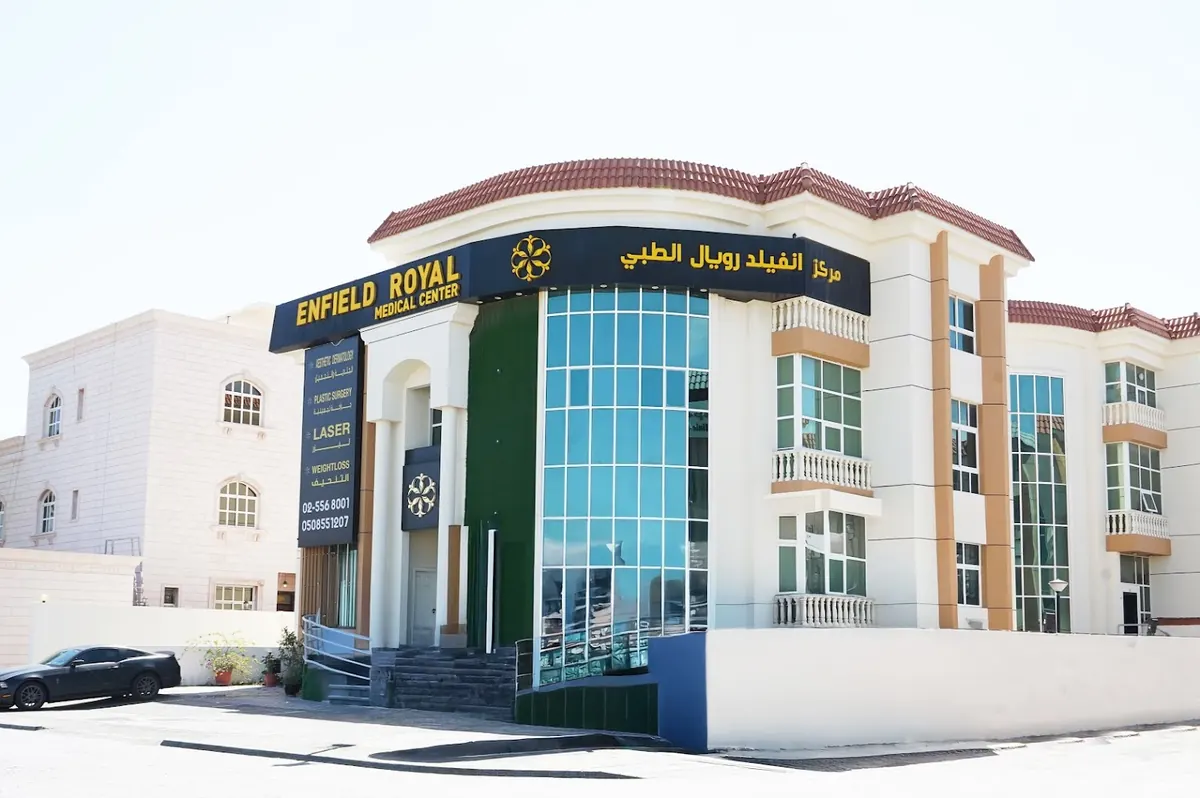
Enfield Royal Clinic is located in Khalifa City, Abu Dhabi — conveniently accessible for clients across Abu Dhabi and Al Ain. Our DOH-licensed team brings specialist-level expertise in aesthetic medicine to every consultation, with a clinical ethos built on transparent communication and personalised treatment design.
If you are considering skin tightening in Abu Dhabi in 2026 or 2027, the most important first step is an honest, thorough assessment — not a treatment booking. Contact us to arrange your complimentary consultation and receive a treatment plan tailored to your skin anatomy, your goals, and your timeline.
Treatments Mentioned in This Article

Facelift
Restore a firmer, more youthful facial contour by repositioning underlying tissue.
Learn More
Brow Lift
Surgical or endoscopic brow elevation to restore a rested, open upper face.
Learn More
Body Contouring
Combine surgical techniques to sculpt and define the body after weight loss, pregnancy or to enhance overall shape.
Learn MoreReady to Begin Your Transformation?
Book a free consultation with our specialist team at Enfield Royal Clinic Khalifa City.